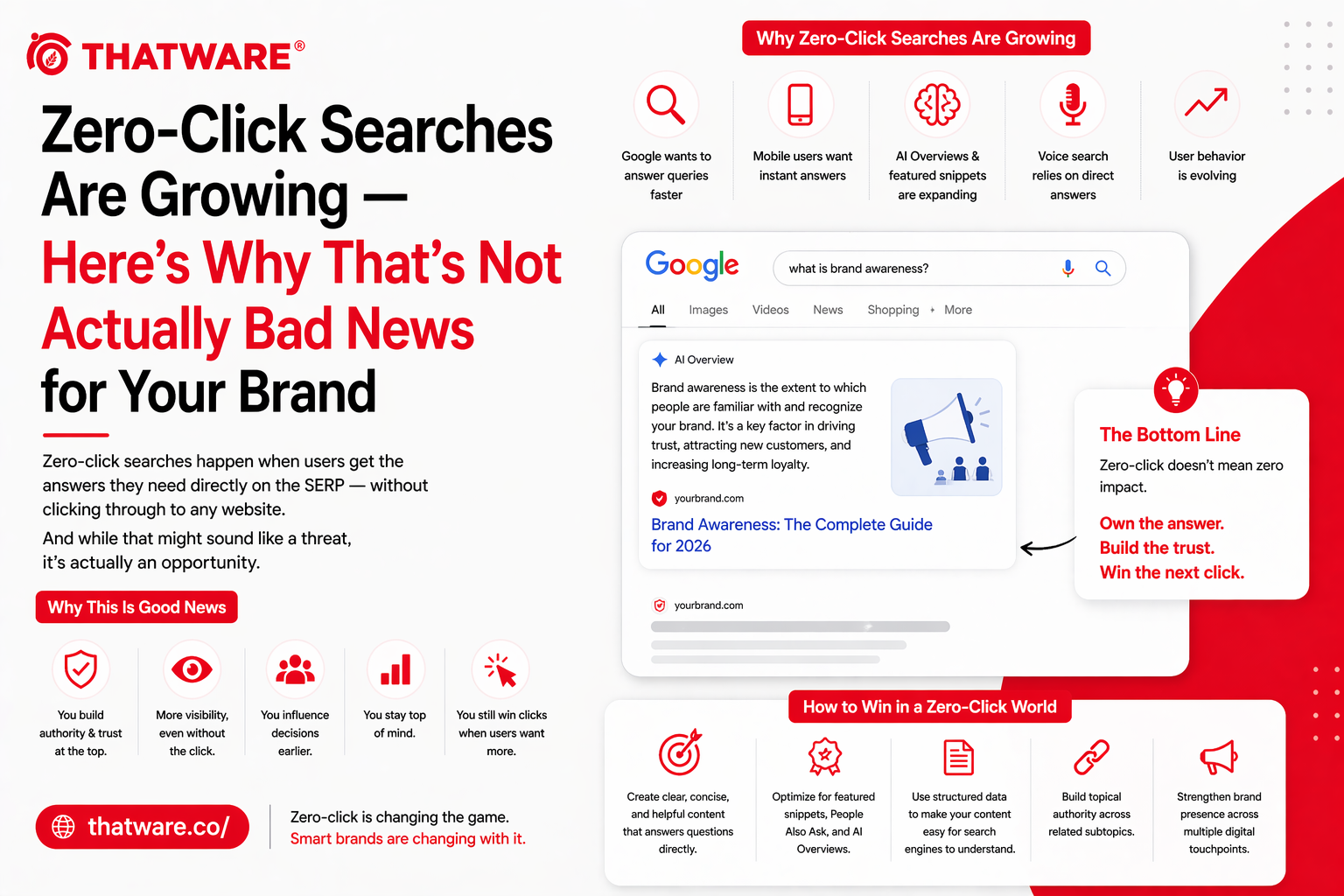
If you’ve spent any time looking at organic search analytics recently, you’ve probably noticed something uncomfortable. Traffic from certain high-impression, high-ranking positions isn’t what it used to be. Featured snippets that once drove meaningful click volume are now sometimes delivering visibility without the click. AI Overviews are synthesizing answers from your content without sending users to your page.
The zero-click trend is real. It’s documented in multiple industry studies. And the initial reaction from most marketing teams is to treat it as a pure loss. Fewer clicks means less traffic means less revenue opportunity.
That reaction makes sense intuitively, but it’s missing some important context that changes the picture considerably.
First, let’s be precise about what “zero-click” means in practice. A zero-click search is one where the user gets their answer from the SERP itself and doesn’t click through to any website. The user isn’t clicking on your competitor either. The search engine is synthesizing the answer, often from your content, and delivering it directly. Your content provided value. You just didn’t get the page visit.
For certain business models, that’s a genuine problem. Publishers who monetize through advertising need the page visit. Businesses that depend on content engagement to build relationships and move users through a funnel need the visit. For these models, zero-click growth is a real challenge worth addressing strategically.
But for a lot of businesses, the loss of click isn’t as significant as it appears, and the associated brand benefits are underweighted in the typical analysis. When Google’s AI Overview cites your content as the source of an answer about a topic in your category, something real is happening for your brand even without the click. Users see your brand associated with the authoritative answer to their question. They may not click now. But that association builds recognition, and branded searches for your business tend to increase when your content is consistently appearing as the source of AI-generated answers.
There’s measurement data supporting this. Sites that have strong AI Overview and featured snippet presence in their category tend to see higher branded search volume over time, even when organic traffic to individual pages has declined due to zero-click behavior. The awareness effect is real even when it’s not captured in click metrics.
The strategic response to zero-click growth isn’t to try to avoid featured snippets and AI Overview appearances (which would be counterproductive given their positive effects on authority perception). It’s to optimize the content that appears in those placements for brand visibility and trust-building, and to ensure the conversion pathways that don’t require an initial content click are strong.
Email capture from branded searches. Retargeting audiences that have seen your brand in AI contexts. Strong brand presence across platforms so that users who encounter you in an AI-generated answer can easily find you elsewhere. These are the conversion pathway adaptations that make sense in a zero-click-growing environment.
From a pure SEO perspective, zero click search seo services that are well-conceived focus on winning the AI Overview and featured snippet placements for high-value terms while also preserving click-through for terms and content types where the page visit matters more. Not all queries are equally affected by zero-click behavior. Transactional queries, navigational queries, and complex research queries where the user wants the full content experience are less zero-click affected than simple informational queries.
aeo services sit at the intersection of this zero-click optimization challenge and the broader shift toward AI-mediated search. Answer Engine Optimization specifically addresses how to structure content to win the answer placements that drive brand visibility even without clicks, while also maintaining the page-visit traffic for queries where it matters. The two objectives aren’t in conflict. They require different content treatments that can coexist in a well-designed content architecture.
The brands that will do best in a growing zero-click environment are the ones that stopped thinking of every search interaction as a traffic opportunity and started thinking of it as a brand touchpoint. Some touchpoints drive immediate visits. Some build the awareness and authority that make future visits more likely. A sophisticated SEO strategy accounts for both.